
Dearborn Heights Resident Lookup Records
One person can appear in several Dearborn Heights record systems without any system being a complete list of residents. The BS&A property hub ties an owner to a parcel and may show a tax-notice mailing address. The Michigan Voter Information Center is a person-level registration tool. A public court result identifies a case, while a probate file can connect a decedent, fiduciary, or heir. Match the record to the question before drawing a conclusion.
| Record | Confirmation it offers | Custodian or portal | Access route |
|---|---|---|---|
| Parcel card | Owner, parcel, situs, and tax mailing facts | Dearborn Heights Assessor / BS&A | Address, owner-name, or parcel search; some detail has claim or payment controls |
| Voter lookup | Registration, polling, and ballot-status information for a matching person | Michigan Voter Information Center | Individual lookup, not a street roster |
| Court index | Public case identity, type, filing dates, status, and disposition where shown | Michigan Courts | Statewide index, then court-of-record copy route |
| Vital event | Birth, death, marriage, or divorce event facts | Dearborn Heights, Wayne County, or MDHHS | Eligibility and written-request rules vary by record |
| Probate file | Estate, fiduciary, heir, and court filing details | Wayne County Probate Court | Recent public documents online; older requests use WCPC81 |
For a current Dearborn Heights identity question, start with the record that has the most reliable name-and-place connection. A name plus parcel can lead to the recorder, while a name plus birth year and ZIP can narrow an individual voter query. For a past Dearborn Heights family question, probate, an obituary, a directory, and a vital-record request may each supply a different part of the trail.
Dearborn Heights Resident Name Checks
The state voter tool asks for first name, last name, birth month, birth year, and ZIP Code. Its results can provide registration status, polling location, sample ballot, and ballot or absentee status for a matching individual. Use spelling variants, initials, and a prior surname when appropriate. A nonmatch does not prove that someone never lived in Dearborn Heights. The person may have moved, have an inactive record, use a different spelling, or have a protected record.
The MVIC lookup is deliberately person-by-person. It is not a public browse tool for a Dearborn Heights block or a downloadable roll. The separate Qualified Voter File request is made in writing to the Michigan Bureau of Elections. It can include public fields such as name, residential address, year of birth, registration date, status, and jurisdiction codes, but MCL 168.509gg protects full birth-date components, phone, email, signature, state identification numbers, and Social Security fragments.
Start with the official Michigan Voter Information Center before relying on a secondary account of a match. Its form illustrates the fields used to narrow an individual search.
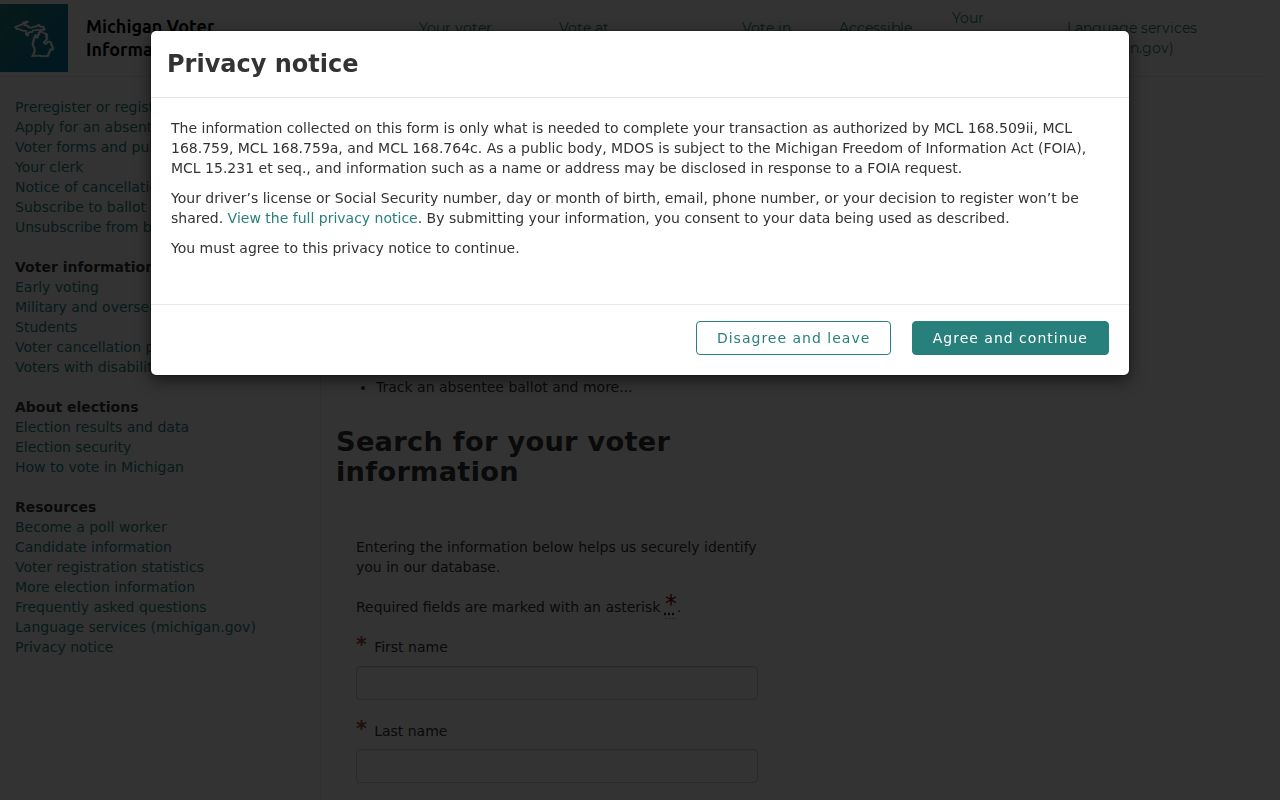
A Dearborn Heights match is an election-record clue, not a complete personal profile. Keep its date and the exact spelling used, then compare it with a separate public record.
Note: Michigan voters do not register by party in the ordinary registration record, and ballot participation never reveals a ballot choice.
Dearborn Heights Resident Property Clues
The Dearborn Heights property system has quick searches by address, owner name, and parcel number. A parcel card can supply an owner name, situs address, mailing address, legal description, assessed or taxable values, sales information, exemption indicators, and related permit or code modules when those fields are available. The sample Dearborn Heights parcel format uses spaced numbers, such as 33 038 01 0479 000. Save the parcel number and legal description because they are more stable than a name-only match.
A situs address is the physical location of the parcel. A mailing address is where a tax notice is sent. They can differ, and either one may change. The city allows a resident to claim up to five properties without charge, while an unclaimed sample detail page offered a $6.95 purchase route. Those access choices affect detail availability, but neither route establishes every person who lives at the property.
When a Dearborn Heights property result is the starting point, use the owner name and legal description in the Wayne County deed index. The free index is a party-name listing, and images or printing use registered, paid, counter, or mail channels. That distinction is useful when a name and an address appear to conflict.
Dearborn Heights Resident Court Checks
The Michigan Courts case search can begin with a last name or case number. Narrow a broad name using first or middle name, birth year, county, court, case type, year, status, or date range when the portal offers those filters. The official sample shows result fields that can include county, court location, court, case type, case number, original case number, filing date, reopen date, status, closed date, disposition, prosecutor, police agency, petition, judge, and police incident. Availability changes by court and case type.
The statewide entry is an index, not the court file. The 20th District Court is the local Dearborn Heights channel for its own cases and can be reached through the clerk counter or phone when no public local search is available. Dearborn Heights court questions can also touch Wayne County Circuit records, which use their own records-room and archive routes. Most public Wayne Probate documents filed since April 1, 2022 are online; older probate documents require the court's WCPC81 copy-request process.
Use the official Michigan Courts search to see the public case-search interface before entering a name.
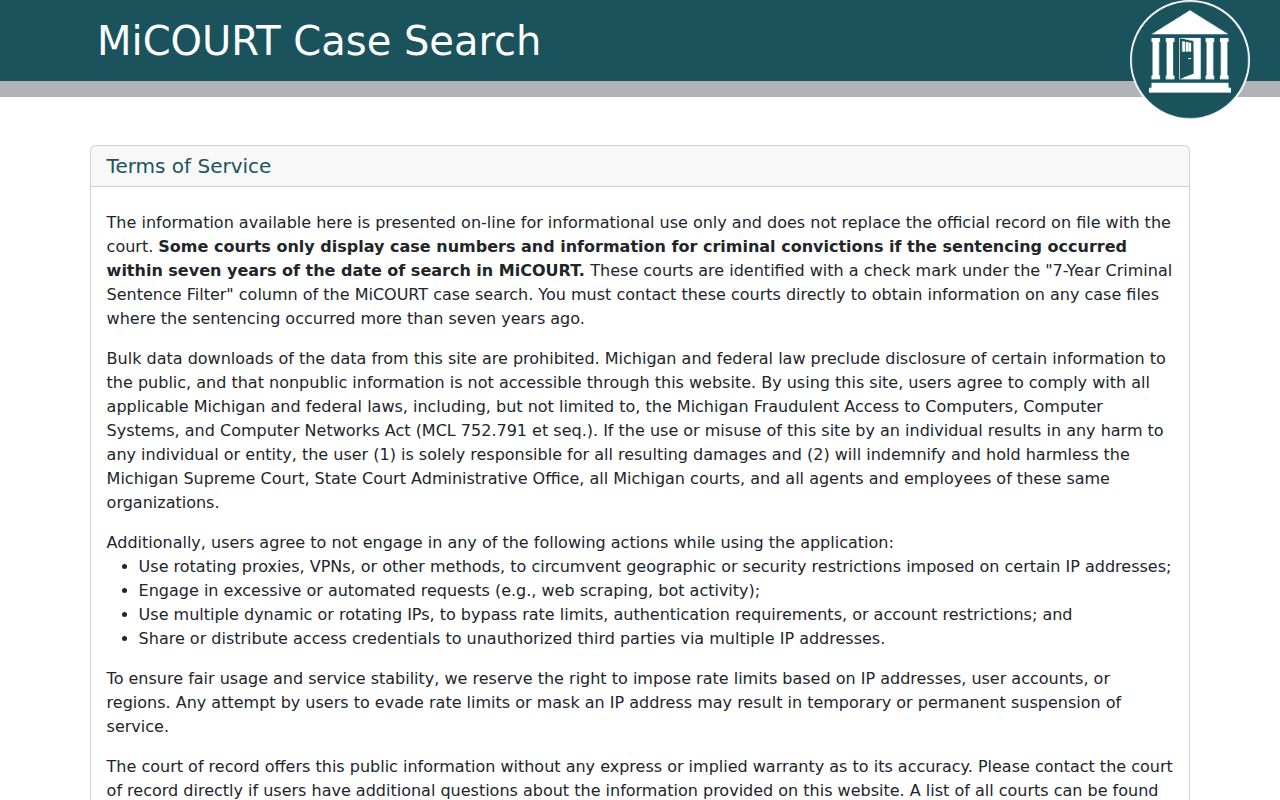
Record the court, case number, and status from a result. Those details make a clerk request much more precise than a same-name search alone.
Excluded or sealed matters can include adoption, juvenile, mental-illness, name-change, and other protected categories. A missing screen result is not proof that no court record exists.
Verify a Dearborn Heights Resident
A careful Dearborn Heights resident lookup builds an identity from records that answer separate questions. Full name, middle initial, year, address, parcel, court, and date are useful cross-checks. Do not merge two same-name records merely because both mention Wayne County. Earlier surnames, punctuation, transliteration, and abbreviated Dearborn Heights street suffixes can change how an index sorts a person.
- Anchor the name with an address, parcel, or election match. Record the spelling, date, and source instead of copying a bare name.
- Check BS&A for an owner, situs, mailing distinction, and legal description. Treat the owner record as a property fact, not an occupancy list.
- Search Michigan Courts with name variants, county, and court filters. Compare the case number, filing date, and disposition before attaching it to the same person.
- Use the court clerk, probate court, Dearborn Heights City Clerk, Wayne County Clerk, or MDHHS when the needed document is held outside the index.
The Dearborn Heights record terms below help separate a searchable pointer from the document that has legal force.
- Docket
- A court's running list of events and filings in a case, usually organized under a case number.
- Index and image
- An index points to a record. An image is the scanned document or filing itself and may have different access or copy rules.
- Certified copy
- A copy issued and certified by the custodian. It is not the same as a portal listing or an informal download.
Note: Write down the court level and index date because a local, circuit, probate, and federal case may use different file systems.
Dearborn Heights Resident Probate
When the question concerns a deceased Dearborn Heights resident or estate, the Wayne County Probate Court is the focused channel. Public filings can identify a decedent, fiduciary, heir, address, order, and case number where the record is open. Pair a Dearborn Heights probate case with a recorded deed, death evidence, obituary, or directory entry. That is more reliable than assuming that a person listed in an estate record lived at a particular property on every date.
Most public documents filed from April 1, 2022 onward are available online through the court's recent-document access. For earlier files, use the WCPC81 copy request and give the clerk the case number if known. A probate record is especially useful when a deed names a grantor or grantee connected to an estate, but the deed and estate have different purposes and dates.
Dearborn Heights Resident Vital Rules
Vital records are confirmation records, not a general name-search database. The Dearborn Heights Clerk can certify a birth or death only when the event occurred in the city. Wayne County and the Michigan Department of Health and Human Services provide other custodial routes. The event location, not merely the person's later residence, determines which office holds the record.
MCL 333.2882 limits birth copies for 100 years. Before that point, the state lists eligibility for the subject, named parent, heir or legal heir, court-appointed guardian, authorized representative, attorney, or a court-order route. Birth records over 100 years are open. Death, marriage, and divorce records may be requested in writing with the fee under the state eligibility rules. A divorce event record is different from the circuit-court case file that contains pleadings and orders.
MDHHS documents online, mail, phone, drop-box, appointment, and Will Call channels. Its standard state fee is $34 plus online processing when applicable, with regular and expedited timing published by the custodian. The Dearborn Heights local Clerk, Wayne County Clerk, library, archive, newspaper, and probate routes remain useful when the state ordering path is not the right one.
Resident Lookup Privacy in Dearborn Heights
A valid resident lookup has hard boundaries. Michigan's Address Confidentiality Program gives eligible survivors a designated address and mail-forwarding protection. Actual physical addresses used in that program are not a public directory field. MCL 168.509gg protects sensitive voter information, and recent birth records have their own statutory limits. DMV addresses, sealed court records, and private utility or delivery data are not casual public lookup material.
If an existing Dearborn Heights city record is not online, use the Dearborn Heights FOIA procedure under Michigan Freedom of Information Act, 1976 PA 442, MCL 15.231 et seq. That route cannot open protected information. If a public record is wrong, contact the office that keeps it. The Dearborn Heights Assessor handles parcel and exemption issues; the appropriate clerk handles court, vital, or city records; the Secretary of State handles voter records; Michigan State Police has a criminal-history review route; and LARA handles license or entity filings. Preserve the source citation and request the specific correction rather than repeating an unverified claim in another setting.
Lawful use. Dearborn Heights records can support family history, reconnecting, estate research, and civic questions. Never use a record to stalk, harass, intimidate, or harm another person.
Note: The Michigan Attorney General's consumer-protection office is the official state route for scam and identity-theft guidance, not a substitute for a custodian correction.
Dearborn Heights Resident History
For a former classmate, family line, or past address, the Dearborn Heights library's directories and street guides, local newspapers, cemetery binders, school collection, charter, and reference staff can supply the historical layer that modern portals lack. The library collection covers directories and street guides from 1930 to 1967, while the Dearborn Heights Leader run covers 1962 to 1975. These sources are annual or dated snapshots, not proof of a person's current location.
The city began from former Dearborn Township sections and an Inkster strip, so older material may use Dearborn Township, Dearborn, or Inkster rather than the modern city label. A historical directory lead can be checked against census, deed, probate, newspaper, or vital evidence. For the collection years and changing labels, consult the Dearborn Heights city directory.