
Dearborn Heights City Directory Holdings
The local Dearborn Heights starting point is the Dearborn Heights Public Library archive. Its Directories and Street Guides Collection is documented as spanning 1930 through 1967, including material from before the city name settled into its modern use. Those Dearborn Heights volumes are useful as year-specific address and name clues, not as a complete roll of every person connected to an address. The archive also holds the Dearborn Heights Leader, cemetery material, school material, a charter, brochures, and a League of Women Voters guide that can test a directory lead.
| Collection | Years | Where Held | Access |
|---|---|---|---|
| Dearborn Heights directories and street guides | 1930-1967 collection span | Dearborn Heights Public Library archive | Reference collection; the public description does not list every edition |
| Dearborn Heights Leader | 1962-1975 | Dearborn Heights Public Library archive | Local news, notices, civic names, and event context |
| Wallaceville Cemetery Binder and Nowlin Cemetery Collection | Not stated | Dearborn Heights Public Library archive | Local family and cemetery leads; confirm the underlying source |
| Polk and Bresser directories for nearby Dearborn | Various years and geographies | Dearborn Public Library and related repositories | Catalog and in-person cross-check for nearby or predecessor labels |
The documented Dearborn Heights range is valuable, but it has an important limit. The public collection description does not identify the individual publisher for each year, every edition, whether a given book is a telephone or criss-cross volume, or a complete reverse-directory run. Ask the reference desk to confirm the actual volume, imprint, year, and page before relying on a publisher or a particular entry format.
Note: A directory year is an address-and-name snapshot, not proof that every person connected with an address appears in that volume.
Dearborn Heights Library Archive Access
The Dearborn Heights archive is supported by two local reference desks. Caroline Kennedy Library is at 24590 George, with reference service at 313-791-3813 and dhreference@gmail.com; its regular hours are Monday through Thursday, 10 a.m. to 9 p.m., and Friday and Saturday, 10 a.m. to 5 p.m. John F. Kennedy Jr. Library is at 24602 Van Born, with reference service at 313-791-6052 and jfkreference@gmail.com; it is open Monday through Thursday, 10 a.m. to 8 p.m., and Friday and Saturday, 10 a.m. to 5 p.m. Both are closed Sunday.
Before visiting a Dearborn Heights branch, give staff the name variants, the approximate year, the address as written in the record, and whether the question is about a street guide, a newspaper, a school source, or cemetery material. The library's genealogy resources also identify in-library Ancestry Library Edition access, while the Dearborn Genealogical Society offers library help at both Heights branches on a varying schedule.
An image from the Dearborn Heights Public Library archive records the local collection categories available for historical research.

The archive list explains why a historical directory search often benefits from a newspaper, cemetery, school, or civic record from the same period.
Dearborn Heights Directory Years
The Directories and Street Guides Collection is the direct Dearborn Heights source for the 1930-1967 span. Its description says that some material predates incorporation. That matters when a family, deed, or newspaper uses Dearborn Township, Dearborn, or Inkster instead of Dearborn Heights. Search the label printed by the older source first, then test the modern city name as a separate search.
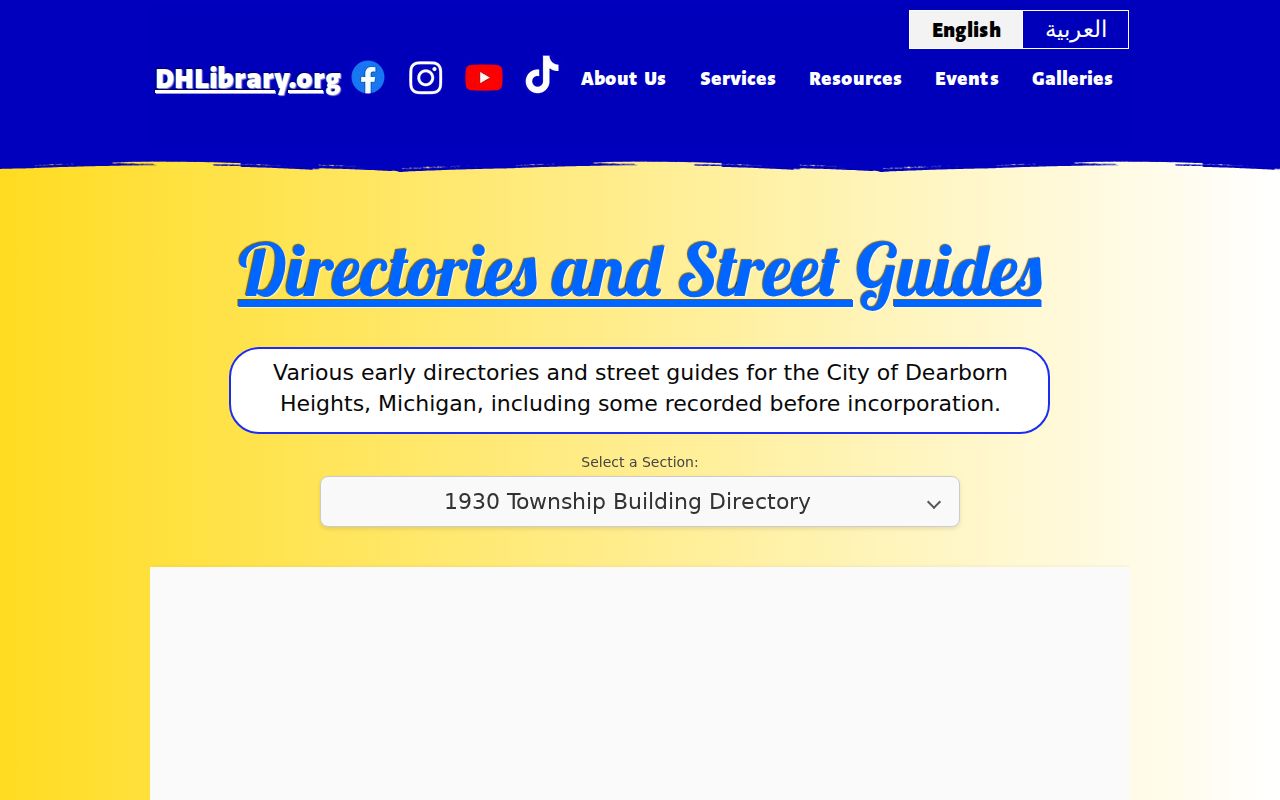
For a concise visual check of the collection description, use the source image below. It is evidence of the library's stated range, not an image of a verified interior directory page.
A capture from the library's directories and street guides page documents its stated local collection coverage.
Use the reference desk to identify the edition and page behind any entry, because the public page does not expose a complete volume-by-volume inventory.
Dearborn Historical Cross-Checks
A historical address that does not appear under Dearborn Heights may belong in the neighboring Dearborn record trail. The Dearborn Public Library local-history resources point to historical directories, newspapers, the Dearborn Historical Museum, and genealogy material. Its physical Polk and Bresser directory volumes cover various years and geographies. The Dearborn library catalog search is the safest route to check a particular title instead of assuming a matching volume exists.
This is not a claim that a Dearborn volume is a Dearborn Heights volume. It is a jurisdiction check. Older material can preserve a predecessor label, a township reference, or a neighboring-city filing practice. Copy the place name exactly, compare street intersections or lot information where available, and keep the repository separate in the citation.
Reading Dearborn Heights Directory Entries
No public image of a local 1930-1967 entry or its abbreviation key was identified in the reviewed archive description. That means a careful reader should record only what the open volume actually prints. A traditional directory may organize surnames alphabetically and may include an address, a relationship notation, a business or occupation line, a telephone number, an owner-status mark, or a reference to an address section. Any of those details is conditional until the local page is inspected.
| Printed name | Transcribe surname, given name, initials, and spelling exactly as the volume presents them. |
|---|---|
| Address line | Record house number, street spelling, unit notation, and the directory year before normalizing anything. |
| Relationship or status | Copy a spouse, widow, estate, ownership, or other notation only when it is printed and explained by the volume. |
| Business, occupation, or telephone | Keep these as year-specific clues, not identity proof, and cite the line where each appears. |
| Page evidence | Save the collection title, edition year, publisher or imprint if shown, page or section, repository, and image or photocopy reference. |
- Criss-cross directory
- An address-ordered section that may place names along a street. Confirm that the local volume actually contains one before using it.
- Householder index
- An index arranged around a named household contact rather than every possible person at an address.
- Abbreviation key
- The printed explanation for shortened terms and marks. Photograph or transcribe it before interpreting any symbol.
Dearborn Heights Directory News Leads
The Dearborn Heights Leader run, 1962-1975, can add local context to a historical Dearborn Heights directory result. For nearby newspaper coverage, the Dearborn-area newspaper collection lists the Dearborn Guide, Dearborn Independent, Dearborn Press, Dearborn Press & Guide, and Times Herald or Downriver Sunday Times in different PDF, microfilm, and catalog ranges. Use a name with a date and address where possible. A newspaper notice can help frame a move, civic activity, death notice, or organization reference, but it should be compared with an official or archival record.
The library's obituary request information cautions that a notice is not guaranteed to exist. Give the library the best available name, approximate date, and newspaper title. A failed request is not proof that no event occurred.
Dearborn Heights Family History Shelves
The local Dearborn Heights archive has several unusually specific companions to a historical directory. The Wallaceville Cemetery Binder and Nowlin Cemetery Collection can supply cemetery or family leads. The Wallaceville School Collection can place a name in a school context. The 1960 Charter, 1967 League of Women Voters Guide, and the 1974 and 1980 city brochures can clarify the civic names and local language used around the same era. These materials do not replace a vital record, deed, or census schedule. They make a Dearborn Heights research trail more precise.
For older federal or county-held material, the Archives of Michigan Wayne County guide points to record groups such as naturalizations and township records. The Dearborn Historical Museum and the Henry Ford Benson Ford Research Center are surrounding-area repositories, not substitute custodians for a Dearborn Heights address. Label their geographic scope plainly in every note.
Timeline for Dearborn Heights Directories
Directory research is stronger when the date is treated as part of the evidence. The local sequence does not begin with a settled municipal label. Dearborn Heights developed from two discontinuous Dearborn Township sections and an Inkster strip. The library holds a 1960 Charter, while the 2007 Master Plan describes incorporation in 1963. Those are dated sources with different wording, not a reason to force one date onto every historical entry.
- 1930-1967: The library documents this as the collection span for local directories and street guides.
- 1960: The archive's Charter is a useful local document anchor during the change in civic labels.
- 1962-1975: The Dearborn Heights Leader adds a local newspaper layer to the directory years.
- 1963: The city Master Plan uses this incorporation date, which should be cited as that source's account.
Each date helps choose search terms. A record that vanishes under a current label may still be present under Dearborn Township, Dearborn, or Inkster.
Trace a Dearborn Heights City Directory Family
Use a historical directory as one step in a family-history trail. Begin with the clearest known year, then write down the name and street exactly as printed. The next goal is continuity, not a quick conclusion. A household can move, be omitted, use initials, or appear under a different community label. Census schedules provide a household snapshot on an enumeration date, while directories can fill the years between those snapshots.
- Locate the earliest available local directory or street guide that matches the surname or address, and record its full citation.
- Check the alphabetical entry and any address-ordered section only if the volume includes one; preserve all printed abbreviations.
- Compare nearby directory years for a move, spelling change, or a repeated street address, noting gaps rather than guessing through them.
- Pair the directory year with the appropriate released census schedule, then use the Leader or neighboring newspaper collections for dated context.
- Use cemetery, obituary, probate, or deed records to test a later endpoint. The historical collections can lead into a modern confirmation through the Dearborn Heights resident lookup when the question shifts to a current official record.
A departure from a listing can reflect many things, including a move, an altered listing practice, a missing year, or death. It is not a finding by itself. The best record trail names the source that supports each transition.
Citing Dearborn Heights Directory Evidence
A usable citation separates what is on the page from what is inferred later. Include the collection name, printed place name, publisher or imprint if visible, edition year, page or section, and holding library. If an archive worker supplied information from an unscanned volume, note the date and the exact reference response. That approach makes it possible to return to the right shelf when a name is common or an address has more than one historical label.
For a current parcel or street-level record, use the Dearborn Heights street directory rather than extending an old directory beyond its year. Modern property systems, postal labels, and historical collections answer different questions. Keeping those sources distinct is the clearest way to preserve a local record trail.
Note: Exact publisher-by-year coverage and a verified local sample page remain reference-desk questions, because the public archive description does not enumerate them.