
Finding Dearborn Heights Resident Records
Good Dearborn Heights resident research starts by matching the first lookup to the question at hand. An address points first to the city assessor and the county parcel map. A known person can be checked through the Michigan Voter Information Center. The result can then be compared against a property, court, or deed record. A past household belongs in the library archive rather than a modern portal. Wayne County is the county seat system. City records, state systems, and library collections each follow their own custody rules. Treat any single index result as a lead.
Work from the clearest fact already in hand. Keep a short source note for every result. A parcel number, legal description, court number, directory year, or repository name makes later checks far easier. The order below separates current work from historical work. It also leaves a route for records that never made it onto the web.
| Official-record route | Commercial finder category |
|---|---|
| States the custodian, record type, access limits, and request route. | May combine public filings, marketing data, and data-broker records into a report. |
| Can provide a source document or a defined records request process. | Can be stale, incomplete, or mismatched and may not identify the originating source. |
| Uses the record's own legal restrictions and correction channel. | Removing a commercial report does not correct the original public record. |
- Check the Dearborn Heights BS&A property hub by address, owner name, or parcel number when the question concerns a property.
- Use the Michigan Voter Information Center for a matching individual, using name, birth month and year, and ZIP.
- Search the Wayne County deed index for recorded parties, then compare the legal description with the parcel.
- For an earlier household, ask the Dearborn Heights library archive for its directories and street guides.
- When the needed record has no public index, use the custodian's counter, mail route, or Michigan FOIA process for an existing record.
Dearborn Heights Residents Record Keepers
No single agency keeps a master roll of Dearborn Heights residents. The city assessor supplies the parcel and owner layer. The Register of Deeds records transfer parties and legal descriptions. Michigan's election system offers a person-level registration lookup. Court clerks and the library hold different kinds of confirmation and historical evidence. For block-by-block work, turn to the Dearborn Heights street directory page. These office cards help you find the right counter before a search begins.
Wayne County Register of Deeds
400 Monroe Street, 7th Floor
Detroit, MI 48226
313-224-5854
Dearborn Heights Clerk and Elections
6045 Fenton
Dearborn Heights, MI 48127
313-791-3439
Dearborn Heights Residents by Parcel
The BS&A municipal hub is the main property-search starting point for Dearborn Heights. Its quick routes are Address, Name, and Parcel Number. One parcel record can connect a situs address, owner name, parcel identifier, tax context, sales, and related city modules. Access depends on the record and account access level. The published sample shows the parcel format 33 038 01 0479 000. A mailing address on the card is just a tax-notice field. It is useful for following a trail. But it is never proof of who lives there.
Claiming up to five properties is described as free. An unclaimed sample detail screen offered a $6.95 purchase route. The city assessor sets assessed and taxable values, and handles transfers and exemptions. The assessor can also answer questions the portal does not expose. For a current-name question, retain the parcel number. Compare it with a voter or deed record rather than trusting one card.
| BS&A search control | Type | Verified use |
|---|---|---|
| Address | Quick-search route | Find a property by its street location |
| Name | Quick-search route | Search an owner-name lead |
| Parcel Number | Quick-search route | Open a known parcel record |
| Claim property / buy detail | Account or payment action | Access depends on property-claim status |
The Dearborn Heights BS&A property hub shows the municipality's property-search entry points.
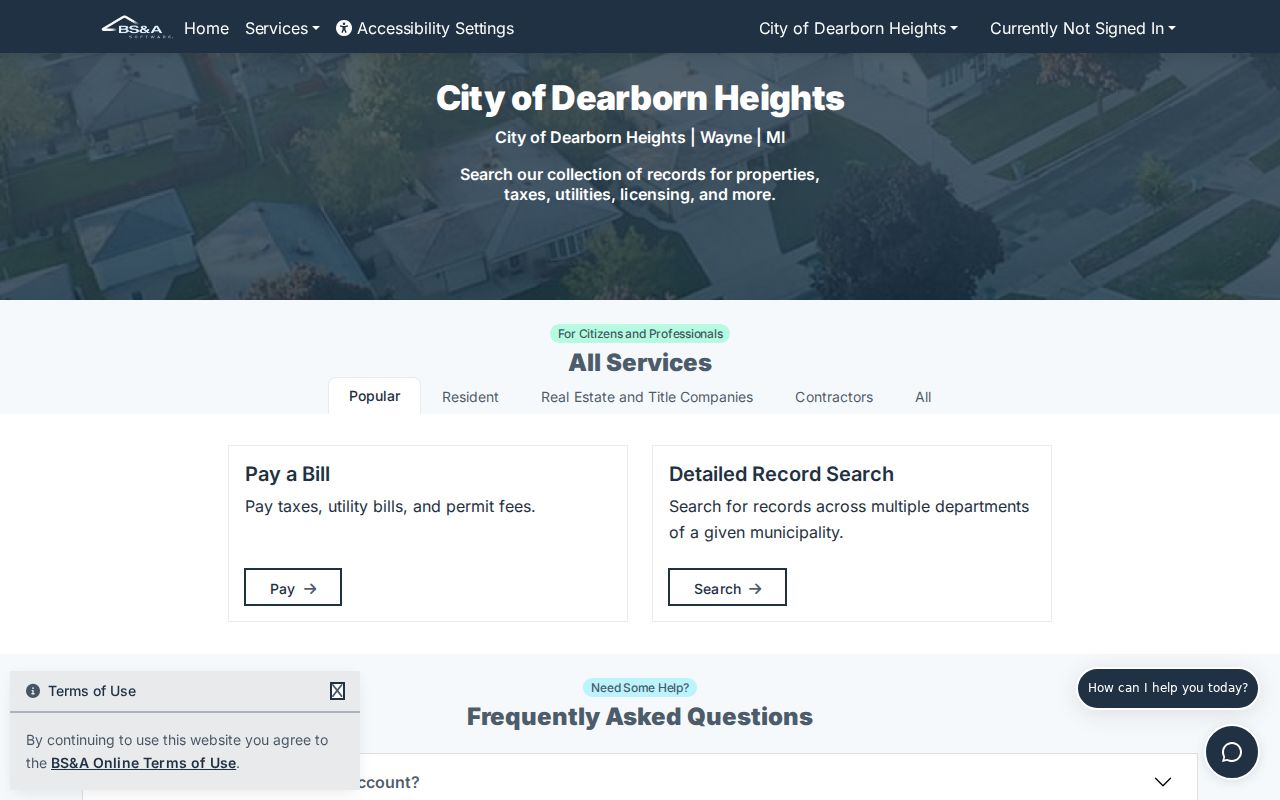
Address, name, and parcel routes all lead back to one thing. The parcel identifier is the bridge that connects property rolls to deed and map records.
Dearborn Heights Residents and Voter Matching
The Michigan Voter Information Center is known as MVIC. It is built for an individual Dearborn Heights match rather than a browseable resident roll. It asks for first name, last name, birth month, birth year, and ZIP Code. A matching result can supply registration, polling-place, sample-ballot, or ballot-status information. It works best when a name and age range are known. No match can also mean a spelling difference. It can mean a moved or inactive status, or a protected record.
The statewide Qualified Voter File is a separate written-request channel. MCL 168.509gg protects phone and email information. It also protects full birth-date components, signatures, driver-license or state-ID data, and other sensitive fields. Michigan's Address Confidentiality Program shields eligible participants too. These limits are part of the record itself. They are not an invitation to guess a private address from an omitted result.
Dearborn Heights Resident Trails in Deeds
Wayne County's public land-record search is party centered. A free public search returns a name listing. Registered or pay-as-you-go access covers images and printing. For a parcel, start with the current owner as grantee. Find the acquisition deed, then search the seller as a prior grantee. Carry the legal description, subdivision, lot, or block through every step. An address alone may not appear in an older instrument.
The county search-services page says recorded-document search reaches back to January 1, 1960. Yet the county home page describes online records as post-1986. Note that difference, and use the office kiosk or a mail search for earlier material. Wayne records a large annual document volume. So a party role, a time frame, and a legal description are the practical checks against a broad surname result.
Dearborn Heights Resident Court Indexes
Michigan keeps a statewide case index covering every court. The Michigan Courts case search accepts a last or business name. First and middle names are optional. Birth year and case number give narrower routes. Public results may list the county, court, case type and number, filing and closing dates, status, disposition, and a few related fields. The 20th District Court serves the city. Its city page posts no local public name-search form, so the clerk counter or a phone call remains the route for the actual local file.
An index is not the court record itself. Adoption, juvenile, sealed, suppressed, expunged, and protected-order categories never fill out a Dearborn Heights name result. Certified copies come from the court of record. Wayne Circuit and Probate records run through separate county channels, and older files can require an archive or copy request.
Current Dearborn Heights Resident Directories
Dearborn Heights resident directories are really several narrow record sets. Each answers one question. Property and tax sources are strongest for parcel ownership. MVIC is built around a single voter match. Recorded deeds name the parties to a transaction, not a whole household. The city staff directory covers roles and contacts. The library's collections are historical, so keeping those boundaries clear makes any lookup more useful and stops a public name from being read as proof of present residence.
| Source | Who It Lists | Keeper | Access |
|---|---|---|---|
| BS&A parcel search | Named owners and property records | Dearborn Heights Assessor | Address, name, and parcel routes; detail access varies |
| MVIC lookup | Matching registered voter information | Michigan Secretary of State | Individual lookup; protected fields remain closed |
| Wayne deed index | Grantors, grantees, and recording trail | Wayne County Register of Deeds | Free listing; paid image, kiosk, and mail routes |
| City staff directory | City roles and public contact information | Dearborn Heights | Free online directory |
| Dearborn Hills Civic Association | Public joining and contact information | Private association | No public member roster |
The best next step depends on the record. An owner entry may lead to a deed. A voter match may need an address or date check, and an old directory name may call for a later court, probate, or vital-record confirmation. Verify a single person against separate sources rather than treating one result as conclusive.
Dearborn Heights Resident Records by Request
Not every useful city record sits online. The Dearborn Heights FOIA process is the documented fallback. It covers existing city records that BS&A does not expose. Michigan's Freedom of Information Act, 1976 PA 442, MCL 15.231 et seq., requires no special statewide form. The city normally responds within five business days, and a ten-business-day extension is possible.
City procedures spell out copy, inspection, deposit, and appeal rules. No request can force a new list. Exemptions still apply. For records held outside the city, use the custodian's own channel. Wayne's recorder mail service handles older deeds. The clerk records room covers court files. A library reference request suits an undigitized collection.
Note: Request an existing record by parcel, address, date range, or file number so the proper Dearborn Heights or Wayne County custodian can locate it.
Dearborn Heights Residents in Library Collections
The Dearborn Heights Public Library archive holds a local grouping that ordinary web searches cannot replace. Its shelves carry directories and street guides, the Dearborn Heights Leader, cemetery material, a school collection, the 1960 Charter, and civic brochures. The directory and street-guide span runs 1930 through 1967. The archive page publishes no publisher-by-year list or sample page. The reference desk answers those questions. Caroline Kennedy Library and John F. Kennedy Jr. Library both provide local reference access, and the Dearborn Genealogical Society helps in the library on a varying schedule.
Some old documents carry different place-names. Dearborn, Dearborn Township, and Inkster appear instead. Nearby Dearborn library and museum collections hold the cross-border historical context, reaching outside today's city lines.
Historical Dearborn Heights Resident Directories
Annual directories and street guides give historical Dearborn Heights residents a dated address clue. They do not give a continuous household history. The library confirms a 1930 through 1967 collection span. The Dearborn Heights Leader ran from 1962 through 1975. Wallaceville and Nowlin cemetery collections, the Wallaceville School Collection, and the 1967 League of Women Voters Guide add local context. A name or address still needs a second source. A deed, census, obituary, probate record, or another dated record can confirm it.
Older material may sit under Dearborn Township, Dearborn, or Inkster. Dearborn Heights formed from separated township sections and an annexed strip. The library archive includes a 1960 Charter. The 2007 Master Plan instead gives 1963 as the incorporation year. Cite each document and its jurisdiction label. The full shelf list, tracing method, and collection limits sit on the Dearborn Heights city directory page.
Dearborn Heights Resident Privacy Boundaries
Public records do not add up to a complete public directory. A property owner may not be every occupant. MVIC is not a street-wide voter roster. A court index leaves out sealed and other excluded matters. Current birth records carry statutory eligibility limits. Michigan's Address Confidentiality Program gives eligible survivors a designated address and mail-forwarding protection, while MCL 168.509gg shields sensitive voter data. Casual utility and DMV lists are not resident sources.
Use a record for a lawful personal purpose. Keep sensitive facts out of your notes, confirm any important result with its custodian, and remember that repeated unwanted contact can violate Michigan's stalking law, MCL 750.411h. Record research should never be used to stalk, harass, or harm a person.
- Parcel
- A numbered unit of land used by the assessor, GIS, and tax systems.
- Situs address
- The physical location of a property, distinct from a tax mailing address.
- Index
- A searchable record listing that may point to, but is not always, the original image or file.
- Criss-cross directory
- An address-oriented directory format that may link a street location to a household entry when a volume includes it.
Dearborn Heights Resident Safety Searches
Michigan's Offender Tracking Information System covers people in state custody. That is its whole scope. The state runs it, not Wayne County. A search form there asks for surname, given name, offender number, sex, race, age, and status. It also asks for identifying marks. Enter a common surname alone and you invite false matches. A clean result still proves nothing about local jail holds, federal cases, or juvenile matters. It proves nothing about anything else the system excludes. Treat OTIS as one statewide record check. Never treat it as the final word on a Dearborn Heights resident lookup.
Michigan OTIS search runs this field-based statewide custody lookup.
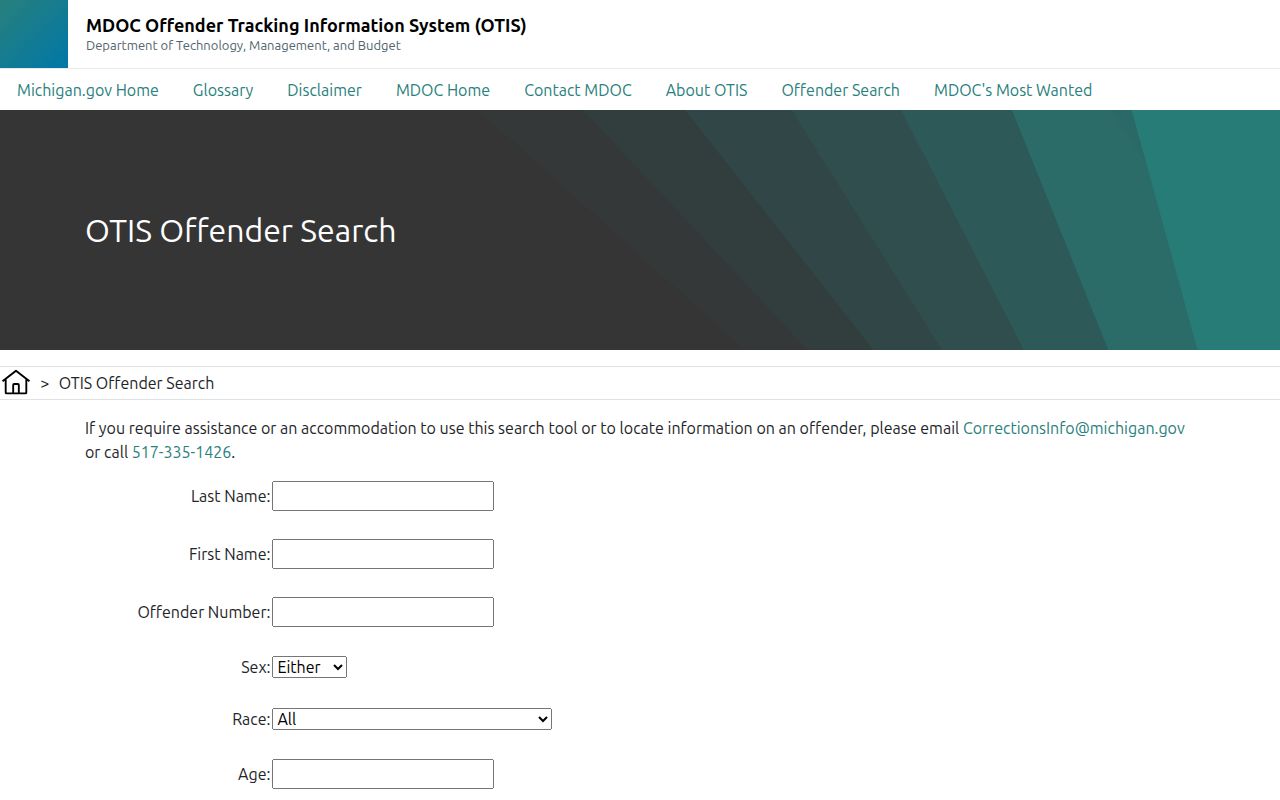
The separate registry interface shows why identity fields beat a lone surname. A lone surname matters in any statewide record program.
The Michigan Public Sex Offender Registry works differently from OTIS. It offers name, number, address, city, county, ZIP code, and radius search modes. Registry entries carry their own legal notices and limits. Victim details and juvenile records stay sealed. The registry never replaces the court of record for a full criminal history.
Michigan's registry search supports both name and location modes.
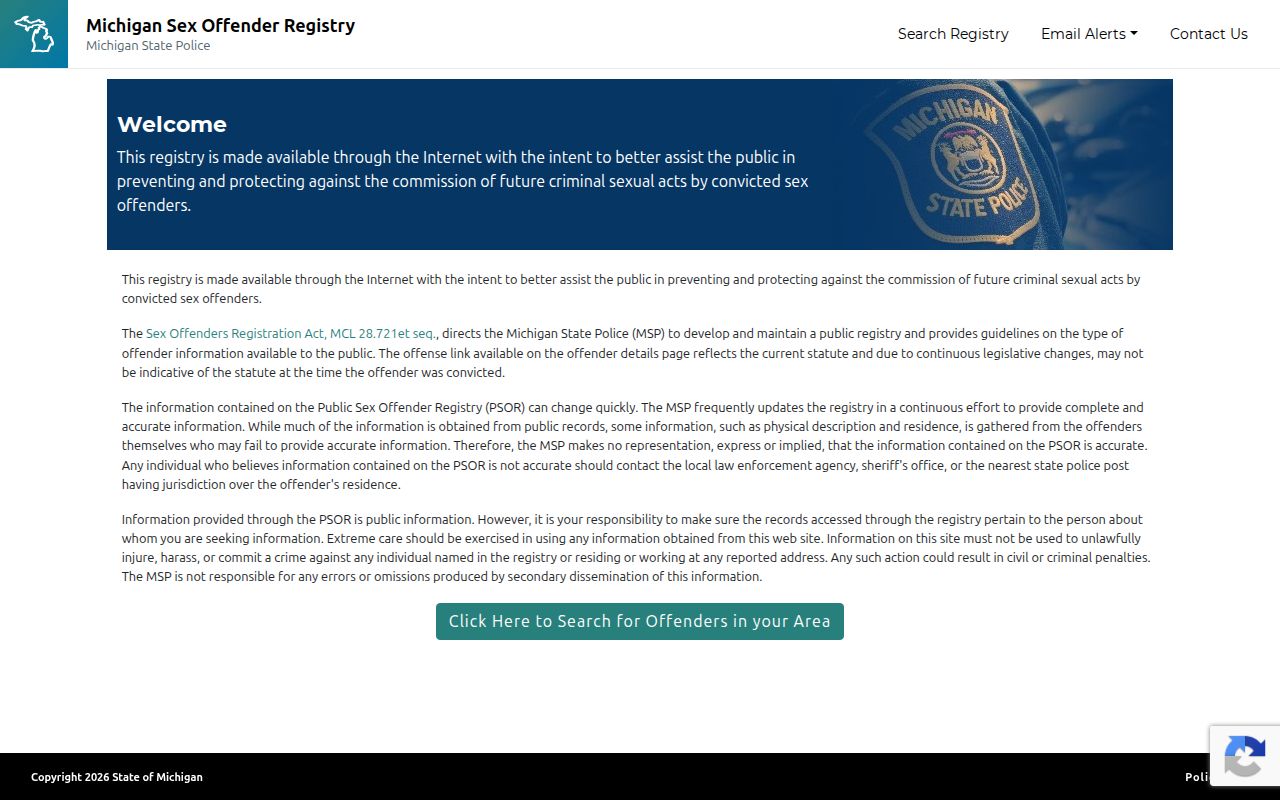
Keeping each program's results in their proper legal context matters here, since registry data answers only the questions it was built for.
Dearborn Heights Residents and Property Alerts
Wayne County offers a free GovOS Property Alert service. It fits neatly into any Dearborn Heights deed-research routine. Subscribe to a name or property. When the recorder files a document against it, you get an email. That is the whole service. It is not a historical deed search, a fraud guarantee, or a substitute for pulling the recorded document itself. Enroll only through the official county channel. A mailed offer quoting a parcel number or charging an inflated copy fee is a pitch to refuse.
Wayne County Property Alert enrollment is the official route for recording notifications.
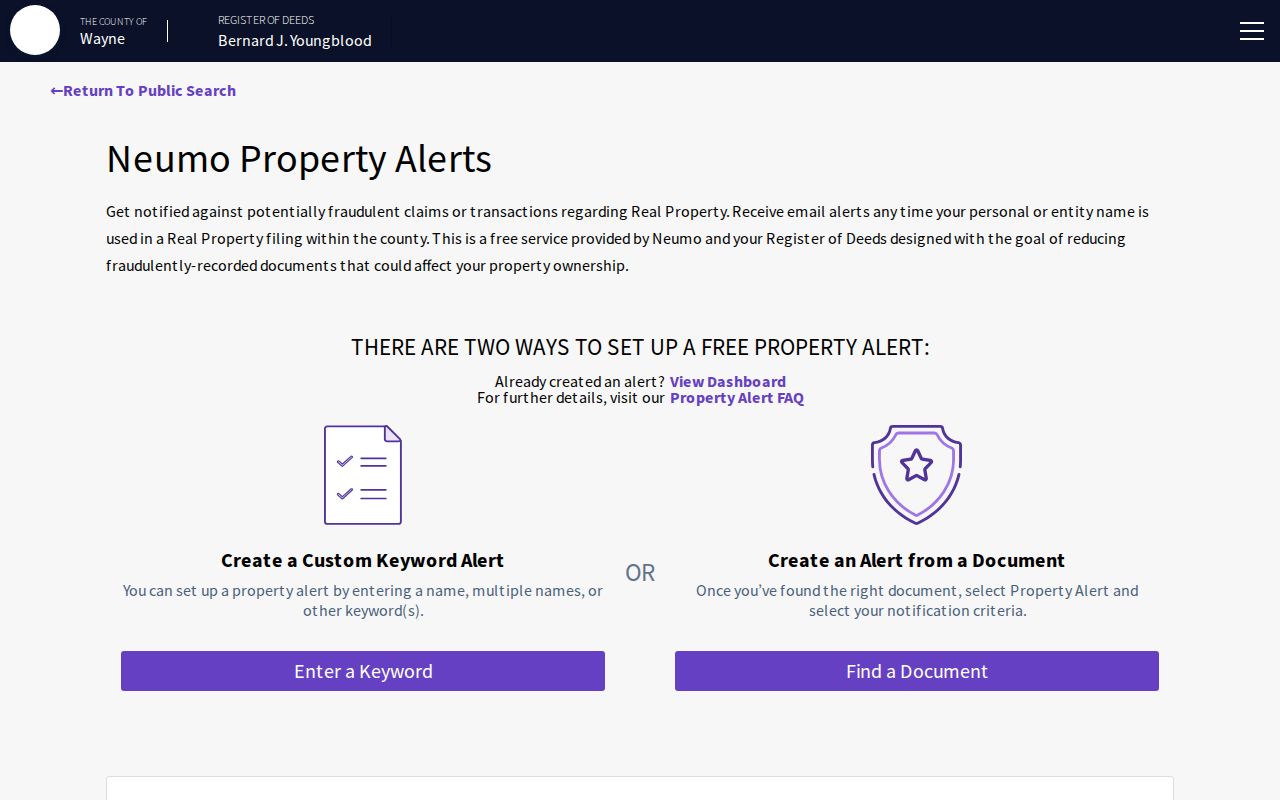
The enrollment screen sits apart from the deed index. Pair any alert with a saved record search and the county custodian's contact details.